-
Halo Round Cut Moissanite Engagement Ring
Regular price From $249.99Regular price -
Round Cut Moissanite Vintage Engagement Ring
Regular price From $149.99Regular price -
Round Cut Moissanite Engagement Ring - Vintage Cluster Shoulders
Regular price From $149.99Regular price -
Round Cut Colorless Moissanite Engagement Ring - Four-Prong Pave Band
Regular price From $149.99Regular price -
Round Cut Colorless Moissanite Engagement Ring - Halo Side Stones
Regular price From $149.99Regular price -
Round Old European Cut Moissanite Vintage Engagement Ring
Regular price From $179.99Regular price -
Round Cut Moissanite Stacking Engagement Ring
Regular price From $149.99Regular price -
Round Cut Moissanite Engagement Ring - Cathedral Pave Band
Regular price From $149.99Regular price -
Round Cut Colorless Moissanite Engagement Ring - Six-Prong Pave Band
Regular price From $149.99Regular price -
Old European Cut Moissanite Engagement Ring - Milgrain Side Stones
Regular price From $179.99Regular price -
Floral Round Cut Moissanite Engagement Ring
Regular price From $149.99Regular price -
Portuguese Cut Colorless Moissanite Engagement Ring
Regular price From $179.99Regular price -
OEC Moissanite Engagement Ring
Regular price From $179.99Regular price -
Round Cut Colorless Moissanite Solitaire Ring
Regular price From $149.99Regular price -
Round Cut Moissanite Halo Engagement Ring - Hexagon Halo
Regular price From $149.99Regular price -
Classic Round Cut Moissanite Engagement Ring
Regular price From $149.99Regular price -
3.35 TW Round Cut Moissanite Cluster Ring
Regular price From $249.99Regular price -
Round Cut Three Stone Moissanite Engagement Ring
Regular price From $149.99Regular price -
Round Cut Moissanite Engagement Ring - Six-Prong Plain Band
Regular price From $149.99Regular price -
4.46 Carat Round Moissanite Cluster Halo Wedding Ring
Regular price From $322.99Regular price -
Round Cut Moissanite Dual Halo Engagement Ring
Regular price From $149.99Regular price -
Portuguese Cut Moissanite Vintage Halo Engagement Ring
Regular price From $179.99Regular price -
Halo Moissanite Semi Mount Engagement Ring
Regular price From $171.69Regular price -
Round Rose Cut Solitaire Moissanite Engagement Ring
Regular price From $149.99Regular price






Common Questions
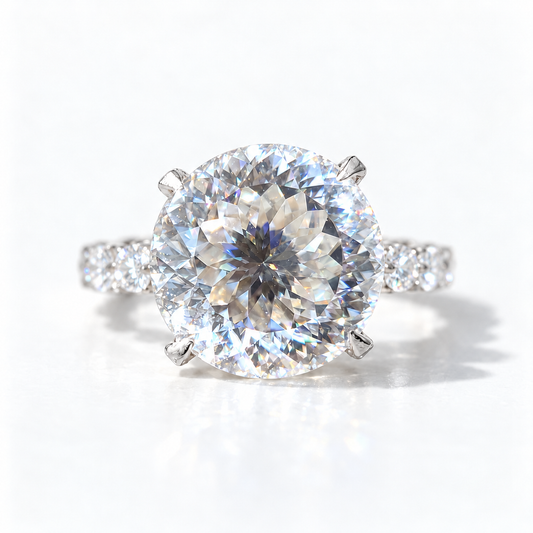
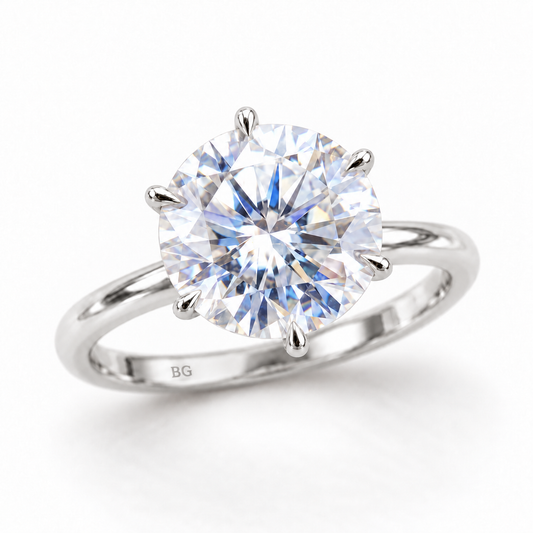
Should I choose four prongs or six prongs?
Four prongs show more of the stone and look a little more modern. Six prongs give extra security and keep the outline round. Both hold a round moissanite well for daily wear.
How big is a 2 carat round moissanite?
About 8 mm across. Moissanite is sized by diamond equivalent, so a 2 ct round moissanite matches the face-up size of a 2 ct round diamond. Check each listing for the exact millimetres.
What is the difference between an old European cut and a round brilliant?
An old European cut has a smaller table, a higher crown and broader facets, so it shows bigger, slower flashes of light. A modern round brilliant has a larger table and many small facets for a crisper sparkle.